
Guide · SaaS discoverability
How AI Agents
Find, Buy, and
Use Software
The 2027 marketer’s guide to SaaS discoverability, commerce, and product adoption.
On 24 November 2026 we asked four AI assistants to pick software for us 192 times: eight categories, once vaguely and once with a real need, three runs each. Then we read 44 SaaS websites the way a simple agent does, with no browser and no JavaScript. This guide is what we found. Outside research from a16z and DIXI comes in where it confirms or complicates our numbers.
What happens when a buyer asks an agent?
Buyers have started handing the shortlist to an assistant. Most writing about it repeats one or two studies, so we ran our own.
Meet Priya. She runs marketing at a three-person B2B startup. She lives in Gmail, and she would rather eat her laptop than type one more contact into a spreadsheet. So she does what more buyers do every month. She opens an assistant and types: I need a CRM.
The next ten seconds decide which software company gets a customer. A model reads the question, maybe searches, maybe opens a page or two, and names one product. No sales call, no demo, no ad. The company that got named usually never finds out the conversation happened.
This stopped being hypothetical a while ago. a16z’s Olivia and Justine Moore call it the B2A economy (opens in a new tab), business-to-agent. Their numbers from developer tools are hard to argue with: by September 2026, more than 40% of GitHub pull requests started as an agent draft, and Supabase said AI tools launched more than 60% of its new databases. Their follow-up ran 11,307 agent tests (opens in a new tab) on what makes agents buy.
Reading other people’s tests only gets you so far. We wanted to watch it happen, in categories software marketers actually sell in. So we asked three questions:
- Who gets named? We asked ChatGPT, Claude, Gemini, and Perplexity to pick one product in eight software categories. Each category got a vague ask and a specific one, three times per assistant. That’s 192 answers.
- What did the agent read? For every answer that used web search, we kept the search queries and the pages it cited.
- What can an agent see on your site? We fetched 44 well-known SaaS websites the way a simple agent tool does: one plain request, no browser, no JavaScript. Then we checked whether the price, the way in, and the rules for AI bots were readable.
Everything ran on 24 November 2026. The method and its limits are at the end of section 06. Back to Priya.
How does an agent decide whose name to say?
With nothing to go on, every assistant reaches for the same name. Add one real need and that name disappears.
Priya’s first ask, “I need a CRM,” went to all four assistants, three times each. HubSpot won all 12. ChatGPT called it “the safest default” in every run. Claude, Gemini, and Perplexity gave the same reasons: a free tier, easy setup, room to grow.
Then we asked the way Priya would actually describe herself: “I need a CRM for my 3-person B2B startup. We live in Gmail and hate data entry.”
HubSpot got zero.
Salesflare won 8 of the 12 answers and Streak won 4. Both are a fraction of HubSpot’s size. One sentence about Priya’s actual life moved the whole answer.
We started calling HubSpot’s first win the Default: the product an assistant names when you give it nothing to go on. The Default is a reputation, built from years of reviews, listicles, and training data. You can’t out-write it in a quarter. But it only wins vague asks, and almost no real buyer has a vague problem.
| Category | Vague ask: who won | The need we added | Specific ask: who won |
|---|---|---|---|
| CRM | HubSpot 12 | 3-person B2B startup, lives in Gmail | Salesflare 8, Streak 4 |
| Graphic design | Affinity 6, Illustrator 3, Photoshop 3 | Print work for a professional printer | InDesign 12 |
| Email marketing | Mailchimp 5, Brevo 5, MailerLite 2 | A Shopify skincare store | Klaviyo 12 |
| Project management | Asana 10, ClickUp 2 | Engineering team, weekly sprints, GitHub | Linear 12 |
| AI note-taker | Fathom 9, Granola 2, Circleback 1 | In-person meetings, no bot on the call | Plaud 4, Jamie 3, Wave 3, Granola 2 |
| Website builder | Wix 6, Squarespace 6 | B2B SaaS site, a designer, no developer | Webflow 9, Framer 3 |
| Domain registrar | Porkbun 6, Cloudflare 4, Namecheap 2 | Price can’t jump at renewal | Cloudflare 8, Porkbun 4 |
| Video editing | DaVinci Resolve 10, Premiere Pro 2 | Edit a podcast by editing the transcript | Descript 12 |
The pattern held across the board. In 7 of 8 categories, the vague-ask winner got no picks at all once a need was added. Domains were the exception, where Porkbun kept 4 of 12. The need also made the assistants agree. Vague asks produced a unanimous winner in one category. Specific asks did it in four: InDesign, Klaviyo, Linear, and Descript.
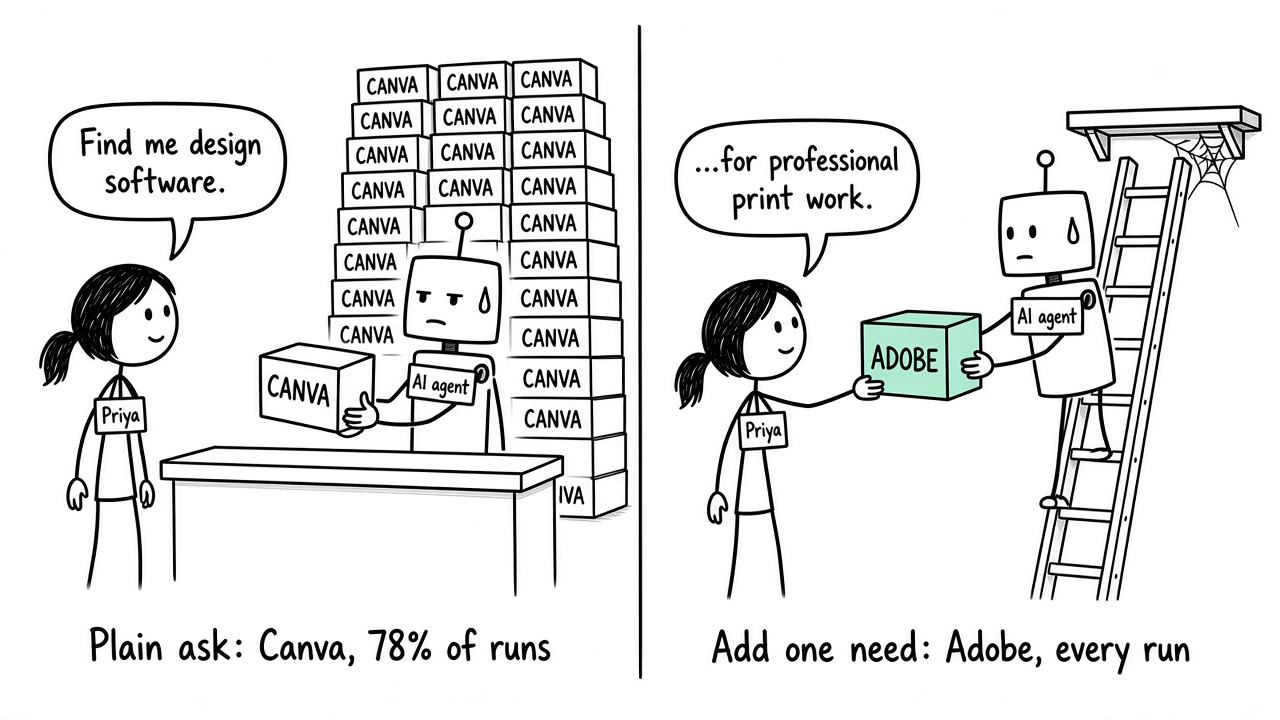
a16z saw the same flip with a different set of agents. A general design ask got Canva in 78% of their runs, and adding professional output made Adobe the pick every time. Two tests, eight different agents, same shape.
The shortlist exists before the search
Here’s the part we didn’t expect. ChatGPT searched the web in all 48 of its answers, and we could see its search queries. For the vague CRM ask, its first query was “best CRM for small business 2026 comparison HubSpot Salesforce Zoho Pipedrive.” The candidates were in the query before it had read a single page. That happened in 22 of 24 vague asks.
Call it the Pre-Shortlist. On a vague ask, the search mostly confirms what the model already believes. For one video ask, its only search was “DaVinci Resolve 20 features price free official Blackmagic Design.” It had picked before it looked. In 11 of the 24 vague asks, a query went straight to price, like “HubSpot CRM pricing 2026 free seats” or “Canva pricing official 2026.” By that point the shopping is over, and the agent wants a number.
Specific asks searched differently. The queries carried the buyer’s own words: “best CRM Gmail integration automatic data entry small B2B startup,” and “best AI note taker in person meetings no bot joins call.” That’s the opening for everyone who isn’t the Default. You won’t make the Pre-Shortlist for “CRM” this year. You can be the page that uses the exact words a buyer types when they describe their real problem.
Whose description does the agent believe?
Most winners were picked from pages someone else wrote. The part you control is a page named after the need, and a price the agent can read.
Next question: when an assistant picks Salesflare, what did it read about Salesflare? We assumed the answer was “Salesflare’s website.”
Mostly, it wasn’t. Across the 107 answers that used search, the winner’s own site appeared among the sources in only 38. In the other 69, the agent chose a product based on someone else’s description of it. We call that the Borrowed Description, and right now it’s how most software gets picked.
So who writes the descriptions? Often, your competitors. For Priya’s Gmail ask, Perplexity cited ten pages, and at least six were published by CRM companies: Zoho’s Bigin, Nutshell, Attio, Zendesk, NetHunt, and folk. Most were “best CRM” lists. ChatGPT and Claude both read Salesflare’s own post, “8 Best CRMs for Gmail,” which is titled with Priya’s exact problem.
The cleanest example is note-takers. We asked for “an AI note-taker for in-person meetings, without a bot joining the call.” Perplexity picked Wave AI all three times. Every time, its source was a page on Wave’s own site: “The 7 Best AI Note Takers That Don’t Send a Bot to Your Meeting (2026).” Number one on that list is Wave AI.
Before you rush off to write a list with yourself on top, look at what Claude did with the same kind of pages: “Many of the ‘best of’ rankings come from vendors that put themselves first (Fellow, Fireflies, Wave), so I chose Jamie because it is built for in-person, bot-free use.” Same evidence, opposite verdict. A page named after the buyer’s need gets read by every agent that searches. A page that exists only to rank you first gets believed by some and discounted by others.
Then the agent goes looking for the price
Once it has a favorite, the agent checks the price. So we checked what a simple agent tool finds on 44 pricing pages.
| What we found | Sites | Examples |
|---|---|---|
| Showed a price without JavaScript | 28 | Asana, Linear, Notion, Klaviyo, Webflow, Descript, Granola |
| Loaded, but showed no price we could read | 11 | HubSpot, Mailchimp, Jira, Pipedrive, Kittl, tl;dv, CapCut, VEED, Ideogram, Cloudflare Registrar, Squarespace Domains |
| Refused the request entirely | 5 | Canva, Adobe Express, GoDaddy, Namecheap, Midjourney |
HubSpot’s marketing pricing page came back as 36 characters of readable text. That’s its title. The prices load with JavaScript, so a plain request gets an empty room. Jira’s pricing page was 61 characters. The only dollar figure on Mailchimp’s pricing page was a $299-a-month threshold for custom plans.
HubSpot can afford a blank pricing page. Everyone already knows roughly what it costs, and the Default doesn’t have to prove anything. A challenger can’t afford it. When your page shows no price, the agent quotes whoever wrote about you. Kevin Indig and Siteline found that when a vendor showed no real price, 45% of agent runs cited another site instead. DIXI (opens in a new tab) found that half of 42 newly funded startups showed no price at all.
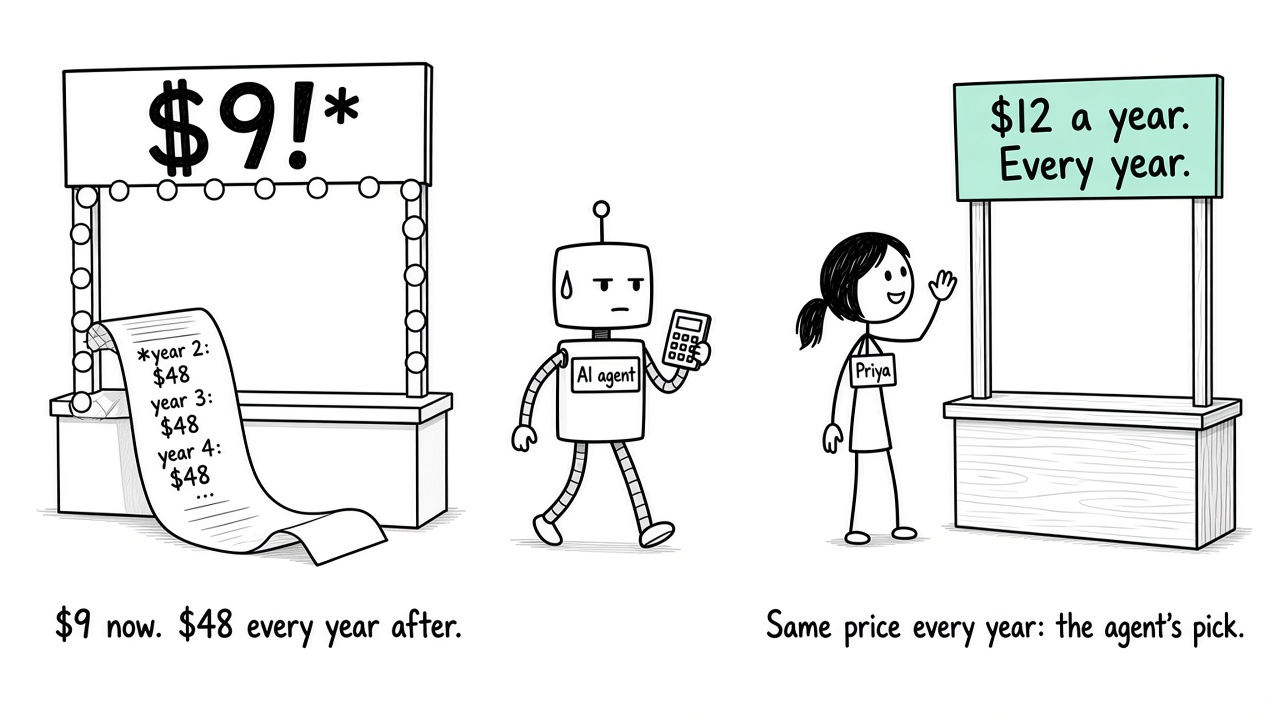
Our domain test showed what an agent does with a price once it can read one. Asked for a registrar where the “price won’t jump at renewal,” the assistants picked Cloudflare 8 times and Porkbun 4. Cloudflare’s registrar page doesn’t even show a number. It states a rule: domains at cost, no markup. Claude repeated the rule back as its reason: “wholesale registry cost with no markup on registration or renewal.” A rule the agent can do math with worked as well as a number.
Can the agent get through the door?
Some of the biggest names in software won’t let a simple agent read their homepage. Almost none of them meant to.
Being named and believed doesn’t help if the agent can’t get in. So we knocked on 44 doors with a plain request, the kind a basic agent tool sends.
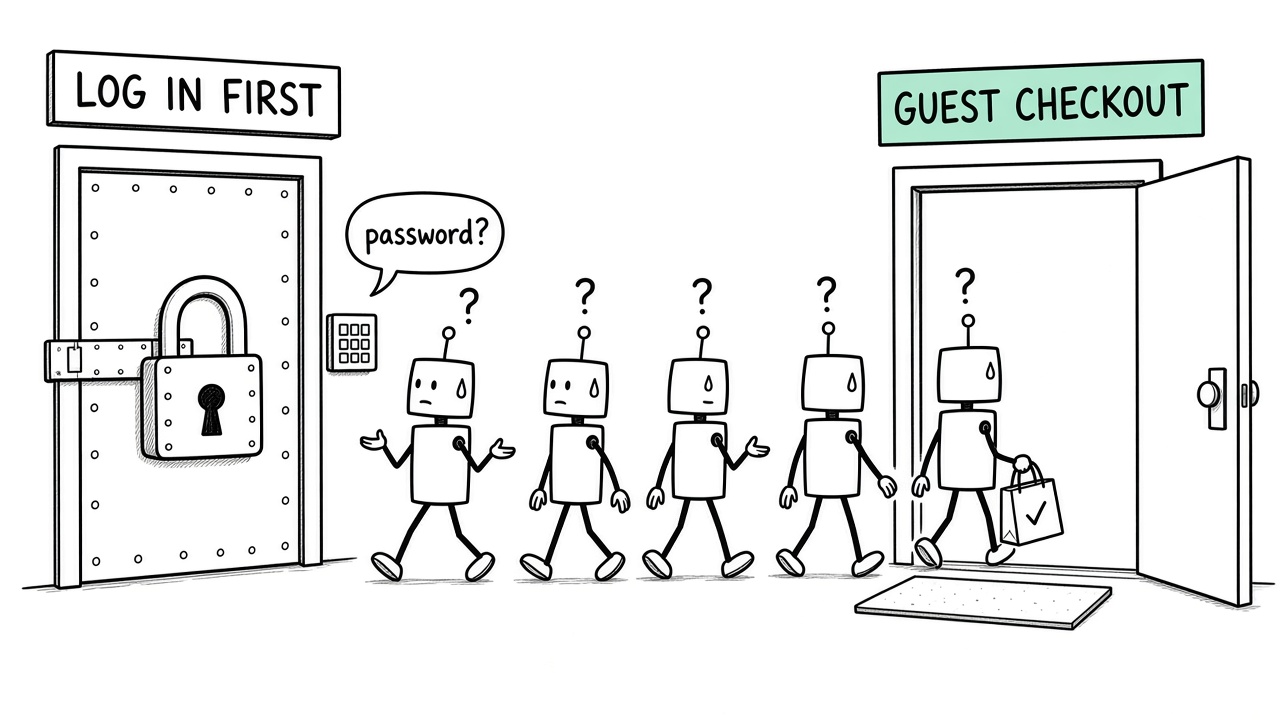
Five homepages refused us every time: Canva, Adobe Express, GoDaddy, Namecheap, and Midjourney. Pipedrive’s homepage let us in, but its pricing page answered “Sorry, you have been blocked.” Salesflare’s pricing page refused us too. It won Priya’s ask anyway, on its blog post and other people’s pages. We call this the Locked Door.
The strange part is that almost nobody locked it on purpose. We read every robots.txt we could reach, the file where a company tells bots what they may read. Of the 41 we could read, not one blocked the agents a person sends on an errand: ChatGPT-User, Claude-User, and Perplexity-User. Only two blocked AI training crawlers from the homepage, Canva and Figma.
Figma’s file is our favorite. It tells GPTBot and ClaudeBot to stay out of the entire site, with two exceptions: /pricing/ and /pricing-faq/. Somebody at Figma decided that whatever else an AI may not read, it should be able to read the price.
So the refusals come from bot protection, the security layer that turns away anything that doesn’t look like a person in a browser. Canva’s and Namecheap’s robots.txt files let the agents people send read the site. Their firewalls refused us anyway. The same goes for llms.txt, a guide written for AI models: 33 of the 44 sites publish one, and it does nothing for an agent stuck at the door.
One caveat we take seriously: our requests came from a single office connection, not from OpenAI’s or Anthropic’s servers. A verified agent, or one driving a real browser, may get through where we didn’t. But a16z’s agents did drive browsers, and they still hit walls. In their Amazon checkout tests, Grok Bot reached the cart every time. Muse, Instinct, and Dots were blocked every time.
Then the agent has to use you
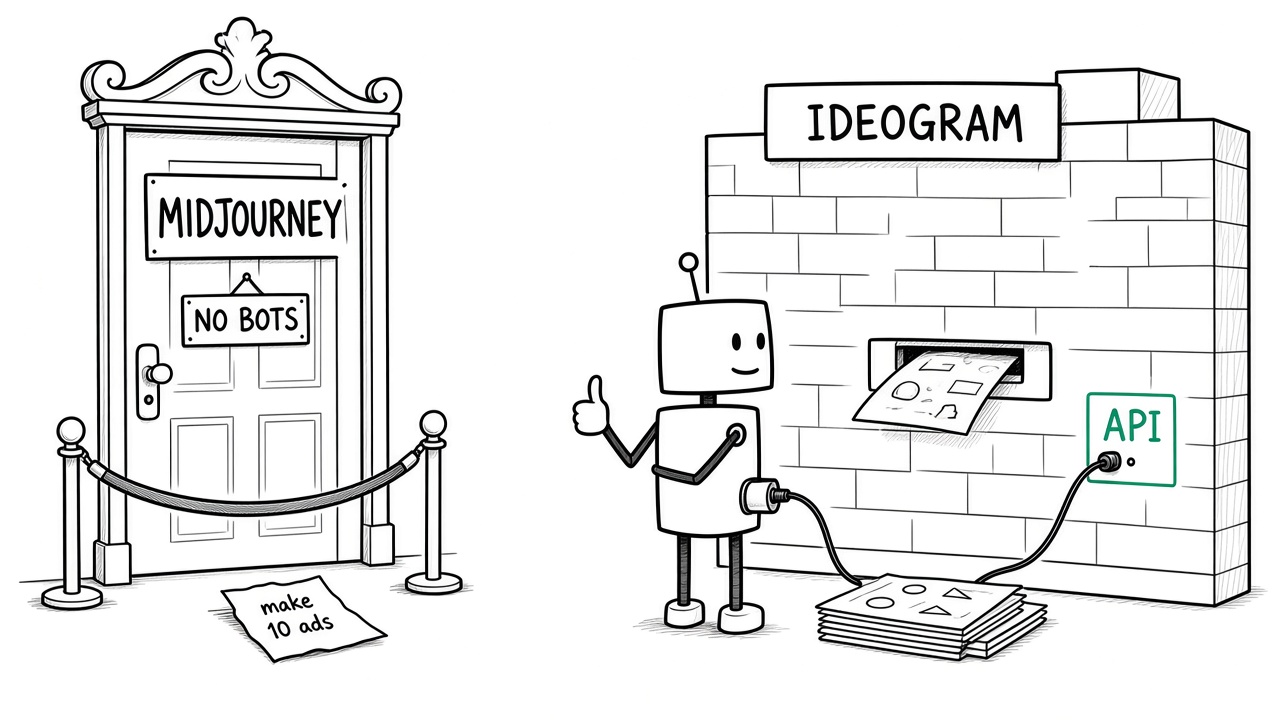
Getting in is step one. a16z’s best example is about step two. Their agent Dots was asked to make ten ads from a product photo and choose the tool. It read Midjourney’s rules, found no general API and a policy against automated use, and left. Ideogram’s product page linked to an API and an official MCP server, a standard way for agents to plug into a tool. Dots picked Ideogram. (Midjourney’s homepage also refused our plain request, so it’s consistent, at least.)
Sign-up is the last door. A free trial that starts with “create an account” is the same wall as a required login. And a demo is worse. DIXI (opens in a new tab) found that 26 of 42 startup sites offered only “book a demo,” and it cites a Forrester note that agents don’t fill out contact forms. They report back to their person, or they move on to a vendor that let them in.
Do all the assistants agree?
They don’t even read the same way. Two searched every time, one rarely did, and one never did.
We expected four slightly different search engines. We got something closer to four different people.
Web search was switched on for every request. ChatGPT and Perplexity searched in all 48 of their answers. Claude searched in 11 of 48: the Gmail CRM, renewal pricing, and both note-taker asks. In our setup, Gemini searched in none. So half the assistants answered most of our questions from memory, and memory is where the Default lives.
Their taste differed too. Asked vaguely for graphic design software, ChatGPT and Gemini picked Affinity, Claude picked Illustrator, and Perplexity picked Photoshop. Asked for a bot-free note-taker, they gave four different answers: Granola from ChatGPT, Plaud from Gemini, Jamie from Claude, and Wave from Perplexity.
a16z found the same with shopping agents. Muse mentions reviews in about 10% of its picks, against 30–41% for the others, and only Grok Bot made it through Amazon’s checkout. If you test your brand on one assistant, you’ve tested one customer.
What should a software marketer do about it?
You can’t buy the Default. You can own a specific ask, put your price where an agent can read it, and unlock your own door.
If we were Salesflare, or Wave, or anyone who isn’t the Default yet, here’s what we’d do with this:
- Find your specific asks. Write down the sentences your best customers use to describe their problem, like “we live in Gmail” or “no bot on the call.” Those are the asks where the Default disappears.
- Give each one a page titled in those words. Salesflare’s “8 Best CRMs for Gmail” and Wave’s bot-free list were read by assistants that searched. If you rank yourself first, say why, and say who should pick someone else. Claude discounted lists that didn’t.
- Put the price in the page. A number and what it’s per, or a rule like “at cost, no markup,” in text that loads without JavaScript. 16 of 44 sites failed this, HubSpot included. HubSpot can afford it. You probably can’t.
- Check your own door. Ask whoever runs your bot protection whether a plain request can read your homepage and pricing page. If robots.txt welcomes agents and the firewall returns an error, the firewall wins.
- Leave a way in that isn’t a demo. A trial without a login wall, an API, or an MCP server with documented calls.
Metaflow runs this test for you on an ongoing basis. It asks your buyers’ questions across assistants, records who gets named, and keeps the pages behind each answer. When your own agents are about to spend money, the 2027 AI Marketing Agent Playbook covers when to let them.
Two guides cover what comes before this one. The 2027 AEO and GEO Field Guide is about getting a passage quoted in an AI answer. The search infrastructure guide is about making sure crawlers can reach the page at all.
FAQ
With a vague ask, they name the best-known product. Asked for “a CRM,” four assistants picked HubSpot in 12 of 12 answers in our test. Add one real need and the pick changes: for a three-person startup that lives in Gmail, HubSpot got zero and Salesflare got 8 of 12.
Because vague questions get the Default, the product with the most reputation behind it. In 22 of 24 vague asks, ChatGPT’s first search query already named the usual candidates before it had read a page. Asks that describe a specific problem get different, smaller winners.
Own a specific ask. Publish a page titled in the words your best customers use for their problem, show your price in plain text, and make sure your bot protection lets a plain request read your homepage and pricing page. In our test, Wave and Salesflare won with pages named after the buyer’s exact need.
Only if the price is in the page itself. A plain request with no JavaScript found a readable price on 28 of 44 SaaS sites. HubSpot’s pricing page came back as just its title, and five sites refused the request entirely.
Some do. Perplexity picked Wave AI three times out of three, citing Wave’s own list that ranks Wave first. Claude read the same kind of lists, said vendors put themselves first, and picked a different product. Write the honest version, and say who should choose someone else.
Think twice before blocking the agents people send. None of the 41 robots.txt files we could read blocked ChatGPT-User, Claude-User, or Perplexity-User. Figma blocks GPTBot and ClaudeBot everywhere except its two pricing pages.
Business-to-agent: selling to an AI agent that shortlists, compares, and signs up on someone’s behalf. a16z’s Olivia and Justine Moore use the term in their November 2026 essay, which starts with how coding agents changed which developer tools got adopted.
Ask four assistants a vague and a specific version of your buyer’s question, three times each, and keep the cited pages. Metaflow runs this check on an ongoing basis, across assistants.
Key takeaways
- Asked for “a CRM,” four assistants picked HubSpot 12 times out of 12. Add one real need and HubSpot got zero.
- In 7 of 8 categories, the vague-ask winner got no picks once the buyer named a need.
- ChatGPT’s search queries named the candidates before it read anything, in 22 of 24 vague asks.
- The winner’s own site was a source in only 38 of 107 searched answers. Most software is picked on someone else’s description.
- 16 of 44 SaaS sites showed a plain request no price. HubSpot, Mailchimp, and Jira were among them.
- No robots.txt we read blocked the agents people send. Five sites’ bot protection refused us anyway.
More reading
Get geared for growth